
Image Source: i.ytimg.com
How To Finish A Quilt With A Sewing Machine: Easy Steps
Can you finish a quilt with a sewing machine? Yes, absolutely! Using a sewing machine is a fast and strong way to add binding to your quilt. What is machine quilt binding? It is the fabric strip sewn around the edge of your quilt using a sewing machine. This process finishes the raw edges and makes your quilt look neat and complete. This guide shows you how to sew binding on a quilt with a machine from start to finish. You will learn an easy quilt binding technique machine users love. We cover making the binding strip, attaching binding to quilt with your machine, making tidy corners, and using your machine for the final stitches to machine finish quilt edge. Let’s get started!
Gathering Your Stuff
You need a few things to bind your quilt with your sewing machine. Having everything ready makes the job easier.
- Your finished quilt: This means the top, batting, and backing are all together. They should be quilted and trimmed nicely. Trim the edges so they are straight and even.
- Fabric for the binding: This is usually 2 1/2 inches wide strips of fabric. You need enough length to go all around your quilt, plus some extra.
- Thread: Pick thread that matches or looks good with your binding fabric. You will need thread for the top and the bobbin.
- Sewing machine: Make sure it is working well.
- Sewing machine needles: Use a sharp needle that is right for quilting fabric.
- Rotary cutter, ruler, and cutting mat: These help you cut straight fabric strips.
- Iron and ironing board: To press the fabric and make the binding nice and flat.
- Pins or sewing clips: To hold the binding in place.
- Scissors: Small ones are good for snipping threads.
Preparing the Binding Fabric
The first step is to make the long fabric strip that will go around your quilt. This strip is called the binding.
Figuring Out How Much Fabric You Need
You need enough fabric strips to go all the way around your quilt’s edge.
- Measure the distance around your quilt. Add up the length of all four sides.
- Add an extra 10 to 12 inches. This gives you enough fabric to join the ends and have a little extra just in case.
- If your quilt measures 200 inches around, you need about 210 to 212 inches of binding strip.
- Most people cut binding strips 2 1/2 inches wide.
- Fabric is usually 42 inches wide. When you cut 2 1/2 inch strips across the fabric width, each strip is about 42 inches long (minus the selvages).
- To find how many strips you need, take the total length you need (like 212 inches) and divide it by the usable width of your fabric (about 40 inches, after cutting off the edges called selvages).
- Example: 212 inches / 40 inches per strip = 5.3 strips.
- You can’t cut parts of strips from the width, so you need 6 strips. Always round up.
Cutting the Binding Strips
You need to cut long, straight strips of fabric. Using a rotary cutter, a long ruler, and a cutting mat is the best way.
- Lay your fabric flat on the cutting mat. Make sure it is smooth.
- Line up one edge of the fabric with a straight line on your mat or ruler. Trim this edge to make it perfectly straight.
- Now, measure 2 1/2 inches from that straight edge using your ruler.
- Hold the ruler down firmly. Use the rotary cutter to cut a strip 2 1/2 inches wide along the ruler edge.
- Repeat this until you have cut all the strips you calculated you need. Remember, if you needed 6 strips, cut 6 strips.
It’s important to cut these strips from edge to edge of the fabric, across the width. This is called crossgrain cutting. It gives the binding a little bit of stretch which helps when you go around corners.
Putting the Strips Together
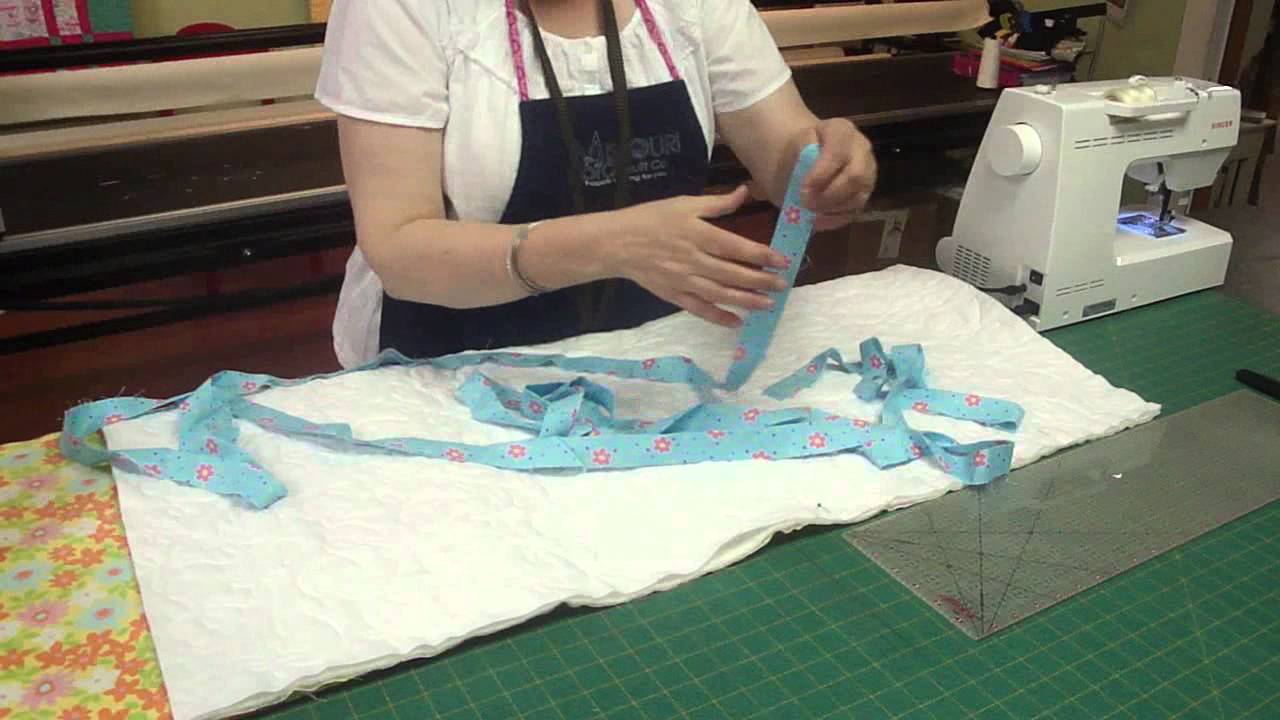
Now you have several strips, each about 40-42 inches long. You need to join them to make one very long strip.
- Take two strips. Place them right sides together.
- Put the ends at a right angle (like an ‘L’ shape). The end of one strip should be across the end of the other.
- Draw a line from one corner to the other corner across the square where the two strips cross. This line goes from the top right corner to the bottom left corner (or top left to bottom right, it does not matter as long as it goes across the point where the edges meet).
- Sew along this line. This joins the strips at an angle. This angled join makes the seam less bulky when folded.
- After sewing, check that the join is correct. Open the strips; they should make one long piece.
- Trim the extra fabric from the seam. Leave a small amount, about a quarter inch, from the sewing line.
- Press the seam open with your iron. Pressing it open makes the join flatter.
- Repeat this process until all your strips are joined into one continuous, long piece of fabric.
Making the Binding Strip Ready
Once the long strip is ready, you need to fold and press it. This prepares it to be sewn onto the quilt.
- Take your long, joined strip to the ironing board.
- Fold the strip in half lengthwise, with the wrong sides of the fabric facing each other.
- Press this fold sharply with your iron. Go along the whole length of the strip.
- Now you have a long strip of fabric, folded in half, with the raw edges lined up along one side and the folded edge on the other. This is your double-fold binding. It is ready to be sewn onto the quilt.
Making the binding this way creates a strong edge that hides the raw fabric edges inside the fold.
Table: Binding Fabric Needed (Example)
| Quilt Edge Length | Extra Needed | Total Binding Length | Strip Width | Fabric Width Used (Approx) | Strips Needed (Total Length / Fabric Width) | Round Up |
|---|---|---|---|---|---|---|
| 200 inches | 12 inches | 212 inches | 2 1/2 inches | 40 inches | 212 / 40 = 5.3 | 6 strips |
| 300 inches | 12 inches | 312 inches | 2 1/2 inches | 40 inches | 312 / 40 = 7.8 | 8 strips |
Remember, add extra fabric for safety. It is better to have too much than too little.
Attaching the Binding to the Quilt
Now comes the part where you start sewing on quilt binding. This step connects the folded binding strip to the outside edge of your quilt. We will attach binding to quilt using your sewing machine.
Starting the Binding
You don’t start sewing right at the very corner of the quilt. You start somewhere along one side, not too close to a corner.
- Pick a side of your quilt to start on. Choose a side that will be less seen, maybe the bottom edge.
- Place the folded binding strip on the top side of the quilt. Line up the raw edges of the binding strip with the raw edge of the quilt (where the quilt top, batting, and backing meet).
- Leave a tail of binding fabric about 8 to 10 inches long hanging loose at the start point. This tail will be used later to join the ends of the binding strip neatly.
- Begin pinning or clipping the binding strip to the quilt edge, starting after that tail. Pin along the edge, keeping the raw edges lined up.
Stitching the Binding On
You will sew the binding strip to the quilt edge using a straight stitch on your sewing machine.
- Place the quilt and pinned binding under your sewing machine foot. Start sewing about 8 to 10 inches from the start of the binding strip (where you left the tail).
- Use a seam allowance of 1/4 inch. This means your stitches will be 1/4 inch away from the raw edge of the quilt. Make sure you are sewing through all layers: binding, quilt top, batting, and backing.
- Sew slowly and keep the raw edges lined up.
- Backstitch a few stitches at the beginning to lock the seam.
- Continue sewing along the side of the quilt.
Handling the Corners (Making Miters)
When you get close to a corner, you need to make a special fold to create a mitered corner. This is how to do mitering quilt binding corners machine.
- Sew down the first side until you are 1/4 inch away from the edge of the quilt (the corner point).
- Stop sewing. Backstitch a few stitches to lock the seam at this point.
- Lift your presser foot. Pull the quilt out from under the foot, but do not cut the thread.
- Turn the quilt so the corner is pointing towards you.
- Fold the binding strip straight up. The fold should go along the edge you just stitched. This makes a triangle shape of binding fabric pointing out from the corner.
- Now, fold the binding strip back down along the next edge of the quilt. The top edge of the folded strip should be even with the edge of the quilt you just stitched along. This second fold makes a nice, neat miter at the corner. The edge of the binding you are about to sew along should be lined up with the raw edge of the quilt.
- Hold this fold in place. You can use a pin or clip to keep it secure.
- Place the quilt back under your machine foot. Start sewing again at the very edge of the quilt, where the fold begins (1/4 inch from the corner point). Backstitch at the start to secure it.
- Continue sewing down the second side of the quilt.
- Repeat this process for the other three corners.
This quilt binding technique machine users master takes a little practice, but it creates very neat corners.
Joining the Binding Ends
After sewing the binding along all four sides and around the corners, you will come back to where you started. You have two tails of binding fabric that need to be joined neatly.
- Sew down the last side of the quilt until you are about 10-12 inches away from your starting point (where the first tail is). Stop sewing and backstitch.
- Lay the quilt flat. Overlap the two binding tails where they meet on the quilt edge. Do not stretch them.
- You need to trim the tails so they overlap by exactly the width of your binding strip (2 1/2 inches if that’s what you cut). A simple way to do this is to open up the tails. Lay one tail flat. Place the end of the other tail over it, marking where they overlap. Then, lay the first tail over the second. Mark it the same way. You want to join them so they fit perfectly into the space left on the quilt edge.
- A common method: Lay the starting tail flat along the edge. Lay the ending tail over it. Measure 2 1/2 inches (or your binding width) past the start of the first tail and trim the ending tail there. Then, take the starting tail, fold it back, and trim it so it overlaps the end of the trimmed ending tail by 2 1/2 inches. This sounds tricky, but you are creating a 2 1/2 inch overlap.
- Once trimmed, open up the two tails. Put them right sides together at a right angle, just like you joined the initial strips.
- Draw a line from corner to corner across the overlap.
- Sew on this line. Check that the strip now fits perfectly in the gap on the quilt edge.
- Trim the seam allowance and press the seam open.
- Finish sewing the last section of binding onto the quilt edge, starting from where you stopped and sewing to where the joined ends now lie. Stitch over the start of your first sewing line to secure it.
Using a continuous quilt binding method like this ensures there is no bulky lump where the binding starts and stops.
Securing the Binding (Machine Finish)
The binding is now sewn to the front of your quilt. The next step is to wrap it around to the back and use your machine to hold it in place. This is the machine finish quilt edge step, also called machine stitch binding or machine sewn binding.
Flipping and Pinning
- Take the quilt to your ironing board. Fold the binding strip away from the quilt top. Press the seam allowance towards the binding. This helps the binding roll nicely to the back.
- Now, flip the quilt over so the back is facing up.
- Wrap the folded edge of the binding strip over the raw edge of the quilt and around to the back. The folded edge of the binding should cover the line of stitches you made when you attached the binding to the front.
- Pin or clip the folded binding edge in place on the back of the quilt. Use plenty of pins or clips to keep it neat and secure. Make sure the folded edge covers the stitches on the back.
- At the corners, the fabric will naturally want to form a miter on the back as well. Fold the fabric neatly to continue the mitered look from the front to the back. Pin the corner miter securely.
Stitching the Binding Down
This is the step where you use your sewing machine to secure the binding on the back. You have a few choices for how to do this machine stitch binding.
Method 1: Stitching from the Front (“Stitch in the Ditch”)
This is a popular quilt binding technique machine users often choose because it looks neat on the front.
- Flip your quilt back over so the front is facing up.
- Place the quilt under your machine foot.
- Stitch along the very edge of the binding, right where the binding meets the quilt top. This is called “stitching in the ditch.”
- Use thread that matches your quilt top fabric in the bobbin (which will show on the back on the binding) and thread that matches your binding fabric in the top needle.
- When you stitch in the ditch on the front, your stitches will go through the binding layers on the back, holding them down.
- Sew carefully, trying to keep your stitches hidden right in the crease between the binding and the quilt top.
- Go slowly, especially around the corners. You will need to pivot carefully to keep stitching right in the ditch around the mitered corners.
- Pros: Looks very clean on the front of the quilt.
- Cons: Can be hard to keep stitches perfectly hidden. If you miss the binding on the back, it won’t be secured there. Requires careful guiding.
Method 2: Stitching from the Back
This method is simpler and ensures you catch the binding on the back, but the stitches will be visible on the front.
- Keep your quilt with the back side facing up.
- Place the quilt under your machine foot.
- Stitch along the inner folded edge of the binding strip on the back of the quilt. Sew about 1/8 inch or a bit less away from the folded edge.
- Use thread that matches your binding fabric in both the top and bobbin. This way, the thread blends in on the back.
- On the front, your stitches will show up on the binding strip, just slightly in from the edge.
- Sew all the way around the quilt, pivoting carefully at the corners to keep your stitch line neat.
- Pros: Easy to ensure the binding is caught and secured on the back. Faster than stitching in the ditch for some.
- Cons: Stitches are visible on the front of the binding. You need to keep your stitch line straight for a tidy look on the front.
Method 3: Using a Decorative Stitch
For a fun look, you can use a decorative stitch to do the machine stitch binding.
- With the back of the quilt facing up, choose a decorative stitch on your machine. A small zigzag stitch, a blanket stitch, or other edge stitches can work.
- Position your needle so the stitch catches the folded edge of the binding and also goes into the quilt back slightly.
- Use thread that looks good with your binding fabric.
- Sew slowly and evenly all the way around the quilt.
- On the front, this stitch will be visible on the binding or where the binding meets the quilt.
- Pros: Adds a decorative touch. Very secure.
- Cons: Stitch is very visible. Requires machine features. Needs careful placement to look good.
Whichever method you choose for the machine sewn binding, take your time. Go slowly and smoothly. Make sure you are catching the folded edge of the binding on the back with your stitches. Check the back periodically to make sure you aren’t missing spots.
Finishing Touches
Once you have stitched all the way around and secured the binding, your quilt is almost done!
- Trim any stray threads.
- Give your quilt a final press with an iron, especially around the binding, to make everything lay flat and neat.
- Inspect your work. Are the corners tidy? Is the binding caught all the way around on the back? If you missed a spot, you can go back and add a few stitches.
Your quilt now has a strong, durable, and neatly finished edge, all done with your sewing machine. This quilt binding by machine method is great for quilts that will get a lot of use, like kids’ quilts or everyday throws.
Tips for Better Machine Binding
Here are some extra tips to help you get a great result when you attach binding to quilt and finish it by machine.
- Use a walking foot: A walking foot helps feed all the layers (quilt and binding) evenly through the machine. This stops puckering and shifting, making your stitches straighter.
- Adjust stitch length: A slightly longer stitch length (maybe 2.5 to 3.0 mm) can look better than a very short one.
- Practice corners: The corners are the trickiest part. Practice the fold on some scrap fabric first if you are unsure.
- Cut straight: Taking time to cut perfectly straight binding strips makes a big difference in how neatly the binding lies on the quilt.
- Press often: Pressing the binding when you fold it and after stitching helps set the seams and makes the fabric behave.
- Start in a less visible spot: If you mess up the binding join or the start/stop point slightly, it is better if it is on the bottom or side of the quilt rather than the top.
- Consider thread color: Matching your thread color to the binding (for stitching on the back) or the quilt top (for stitch in the ditch) helps the stitches blend in. Using slightly darker thread can also help hide small wobbles in stitching.
- Binder attachments: Some sewing machines or specialized quilting machines have binding attachments that can help fold and feed the binding for you. These require practice but can speed up the process. They are a more advanced quilt binding technique machine option.
- Checking the back: Regularly lift the quilt as you stitch from the front (stitch in the ditch) to make sure your bobbin thread is catching the binding on the back.
Other Machine Binding Methods (Briefly)
While the method described above (sewing to the front first, then folding to the back and stitching down) is the most common quilt binding technique machine, there are other ways to finish a quilt with a sewing machine.
- One-Step Binding: Some machines or special feet allow you to fold the binding around the edge and stitch it all in one pass. This requires precise cutting and feeding but can be very fast.
- Binding Sewn to Back First: You can sew the binding strip to the back of the quilt first, then fold it around to the front and secure it by machine (stitching near the folded edge on the front). This makes the stitches visible on the front binding strip.
The process of quilt binding by machine is flexible. The method of sewing to the front first is popular because it gives you more control over how the binding looks on the public-facing side of the quilt before you secure it on the back.
Benefits of Machine Binding
Why choose to attach binding to quilt and finish it by machine?
- Speed: Machine binding is much faster than sewing the binding down by hand.
- Strength: Machine stitches are generally stronger and more durable than hand stitches, especially important for quilts that will be washed and used often.
- Consistency: Machine stitching can be very even and consistent, leading to a neat finish.
- Looks: A well-done machine finish, especially stitch in the ditch, can look very professional and clean.
It is a practical skill for any machine quilter. The machine sewn binding creates a sturdy edge ready for years of use.
Comparing Machine Binding Methods
Let’s look at the two main ways to secure the binding with your machine: stitching from the front (stitch in the ditch) versus stitching from the back.
| Feature | Stitch from Front (Stitch in the Ditch) | Stitch from Back |
|---|---|---|
| Stitch Visibility (Front) | Hidden in the seam (“ditch”) | Visible on the binding strip |
| Stitch Visibility (Back) | Visible on the binding strip | Blends into binding strip (if matching thread) |
| Ease of Catching Binding | Harder to ensure you catch the binding on back | Easier to ensure you catch the binding on back |
| Control | Good control over front appearance | Good control over back security |
| Appearance | Clean front, stitches show on back | Stitches show on front, clean-ish back (with match) |
| Skill Level | Requires precision for hidden stitches | Easier placement of stitches |
Choosing the right machine stitch binding method depends on what look you prefer and what you find easiest to control on your machine. Both create a solid machine finish quilt edge.
Common Issues and Fixes
Even with easy steps, sometimes things go wrong when you sew binding on a quilt with a machine.
- Binding doesn’t cover the stitches on the back: This means the folded edge wasn’t wide enough or wasn’t pulled over enough when pinning. You might need to go back and hand stitch those areas, or machine stitch again closer to the edge on the back.
- Puckering: The layers are not feeding evenly. Make sure you are not stretching the binding or the quilt. Use a walking foot. Check your tension settings.
- Corners don’t miter neatly: Practice is key. Make sure you stop exactly 1/4 inch from the corner and fold the binding sharply and correctly before folding back down. Pins help hold the fold.
- Binding tails don’t join perfectly: This is a common challenge. Carefully measure your overlap before trimming and sewing. Take your time with the angled seam.
- Stitches miss the binding on the back (stitch in the ditch): If you are stitching from the front, you must angle your needle slightly into the “ditch.” Check the back often. If you miss, you can sew another line of stitches slightly closer to the edge or hand stitch the missed spot.
Don’t get frustrated! Machine binding gets easier with practice. Every quilt is a chance to improve your quilt binding technique machine.
Machine Finish Quilt Edge: A Summary
Let’s quickly review the steps for how to sew binding on a quilt with a machine.
- Get your supplies ready: Quilt, binding fabric, thread, tools.
- Prepare the binding: Cut 2 1/2 inch strips, join them with angled seams into one long strip, press in half lengthwise. This includes methods like continuous quilt binding.
- Attach binding to quilt (front): Start away from a corner, leave a tail, sew the raw edges of the folded binding to the raw edge of the quilt using a 1/4 inch seam allowance.
- Handle corners: Stop 1/4 inch from the corner, fold up, then fold down to create a miter. Sew from the edge of the quilt down the next side. This is mitering quilt binding corners machine.
- Join ends: Stop sewing before the start, join the two tails with an angled seam, finish sewing the last bit.
- Secure the binding (back): Flip the quilt over, fold the binding to the back, covering the seam line. Pin or clip in place. This is the machine finish quilt edge.
- Machine stitch binding down: Stitch from the front (“stitch in the ditch”) or the back (along the folded edge) to secure the binding. This creates the final machine sewn binding.
- Trim threads and press.
Following these steps provides a strong quilt binding by machine finish.
Frequently Asked Questions (FAQ)
Q: How wide should my binding strips be?
A: The most common width for double-fold binding is 2 1/2 inches. This gives a finished binding width of about 1/2 inch. You can use other widths, but 2 1/2 inches is a good standard size.
Q: How much fabric do I need for binding?
A: Measure the total distance around your quilt’s edges. Add 10-12 inches extra. Divide this total length by the usable width of your fabric (usually around 40 inches). Round up to the next whole number to get the number of 2 1/2 inch strips to cut.
Q: Can I sew binding onto a round quilt by machine?
A: Yes, you can, but it is trickier. You usually need to cut the binding on the bias (at a 45-degree angle to the fabric edge) instead of the crossgrain. Bias binding has more stretch, which is needed to go smoothly around curves. The stitching steps are similar, but there are no corners to miter.
Q: What kind of stitch should I use for machine binding?
A: A standard straight stitch is used to attach the binding to the front. For the final step of securing the binding on the back (machine stitch binding), you can use a straight stitch (either stitching from the front or the back) or a decorative stitch like a zigzag or blanket stitch.
Q: My machine binding looks messy on the back. What did I do wrong?
A: This often happens if you are stitching from the front (stitch in the ditch) and not catching the binding on the back consistently. Make sure you are pulling the binding firmly but not stretching it to the back, and that your needle position or stitch line is close enough to the edge on the front to catch the folded binding on the back. Using a walking foot helps keep layers flat. Pinning well on the back is also important.
Q: Is machine binding as good as hand binding?
A: They are different! Machine binding is much faster and generally more durable, making it great for utility quilts. Hand binding gives a lovely, almost invisible finish on the back and is often preferred for show quilts or where a softer edge is wanted. One isn’t necessarily “better,” just different in look, time, and durability. Learning quilt binding by machine adds a great tool to your quilting skills.
Finishing your quilt with your sewing machine is a practical skill that will save you a lot of time. With a little practice, you will be able to add neat and strong machine sewn binding to all your projects!