
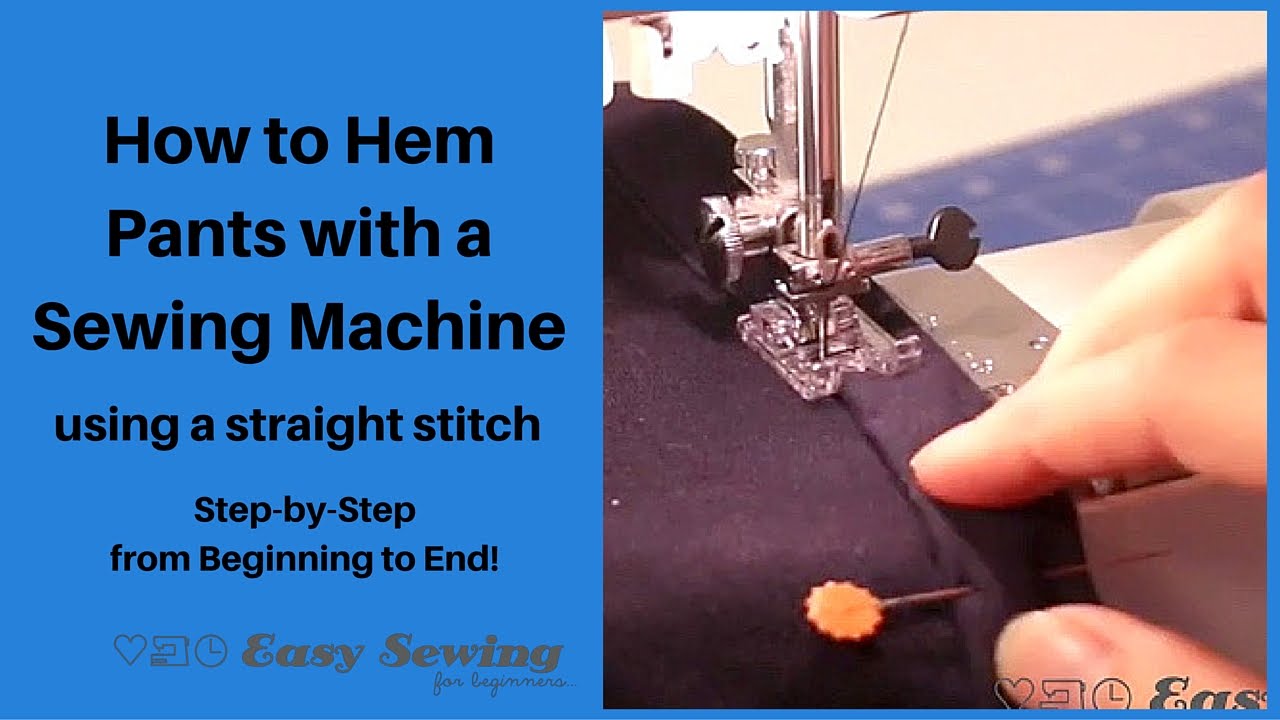
Image Source: i.ytimg.com
Easy Hemming: How to Hem Slacks With a Sewing Machine
Yes, you can absolutely hem slacks with a sewing machine! It’s a common and achievable sewing task that can save you money and give your trousers a perfect fit. This guide will walk you through the entire process, from preparing your slacks to creating a clean, professional-looking hem.
Gathering Your Supplies
Before you start sewing, gather everything you need. This ensures a smooth and efficient hemming experience.
- Sewing Machine: Make sure your machine is in good working order and has a needle appropriate for your fabric.
- Thread: Choose thread that matches your slacks. All-purpose polyester thread is a good choice for most fabrics.
- Fabric Scissors: Sharp scissors are crucial for a clean cut.
- Measuring Tape or Ruler: For accurate measurements.
- Fabric Marker or Chalk: To mark your hemline.
- Straight Pins: To hold the hem in place while you sew.
- Iron and Ironing Board: For pressing seams and hems, which is key to a professional finish.
- Seam Ripper: In case you need to undo any stitches or remove an old hem.
- Your Slacks: Of course!
Preparing Your Slacks for Hemming
Proper preparation is the foundation of a good hem. Taking the time here will prevent issues later.
Deciding on the Hem Length
First, you need to determine how long you want your slacks to be. Try them on with the shoes you’ll typically wear with them. Have someone else help you pin the desired length, or stand in front of a mirror and carefully mark the length with a fabric marker or chalk.
- Consider the break: Do you want a “full break” where the fabric folds heavily on top of your shoes, a “half break,” or a “no break” where the hem just touches the top of the shoe? This is a style choice that affects the final look.
- Standing versus sitting: Pant length can look different when you’re sitting down compared to standing. If you often wear your slacks while seated, consider this when measuring.
Measuring and Marking the Hemline
Once you’ve decided on the length, it’s time to mark.
- Add hem allowance: Most slacks have a hem allowance of about 1 to 1.5 inches (2.5 to 3.8 cm) at the bottom. This is the fabric that will be folded up to create the hem. If your slacks don’t have enough allowance, you may need to adjust your hemming method or accept a slightly shorter hem.
- Marking:
- Stand the slacks up.
- Measure from the desired finished length upwards and mark a straight line all the way around the leg. Use a measuring tape held parallel to the floor.
- If you’re removing an old hem, carefully unpick it first using a seam ripper. Then, measure from the newly revealed raw edge to determine your new hem length.
Cutting Off Excess Fabric
After marking, you’ll need to cut off the excess fabric, leaving your hem allowance.
- Use sharp scissors: This ensures a clean cut.
- Cut precisely: Cut along your marked line.
- Check for evenness: Make sure the hem is the same length all around the leg. You can do this by re-measuring.
Folding and Pressing the Hem
Pressing is a crucial step in creating a neat and professional hem. Don’t skip it!
Creating the First Fold
- Fold up the hem allowance: Take the marked line and fold the raw edge of the fabric upwards, so the raw edge is hidden against the inside of the pant leg. The fold should align with your marked hemline.
- Press with an iron: Use your iron to press this fold flat. This creates a crisp crease. Work your way around the entire leg.
Creating the Second Fold (for a Double-Fold Hem)
A double-fold hem is the most common and durable type for slacks. It encloses the raw edge, preventing fraying and giving a clean finish.
- Fold again: Take the first fold you just pressed and fold it up again. This second fold should be the same width as the first fold. So, if your hem allowance was 1.5 inches, you’ll fold up 0.75 inches, and then another 0.75 inches. The goal is to have the raw edge completely enclosed within these two folds.
- Press again: Press this second fold firmly. You should now have a neatly folded hem that’s ready for sewing.
Pinning the Hem in Place
Once the hem is folded and pressed, you need to secure it before sewing.
- Pinning: Use straight pins to hold the folded hem in place. Place pins perpendicular to the folded edge, about every 2-3 inches (5-7 cm). The pins should go through all the layers of the fabric.
- Check the hang: As you pin, periodically check that the fabric is hanging smoothly and that the hem is even from the outside.
Sewing the Hem with Your Sewing Machine
Now comes the actual sewing part. This is where your sewing machine pants hem will take shape.
Setting Up Your Sewing Machine
- Needle: Ensure you have the correct needle for your fabric type. A universal needle is often sufficient for most slacks, but a sharp or microtex needle can be better for finer fabrics.
- Thread: Thread your machine with matching thread.
- Stitch Selection:
- Straight Stitch: This is the most common stitch for hemming.
- Stitch Length: A stitch length of 2.0 to 2.5 mm is usually good for a clean and secure hem.
- Backstitching: Remember to backstitch at the beginning and end of your stitching to secure the threads.
- Presser Foot: A standard presser foot is usually fine. However, if you’re dealing with thicker fabrics or want to create a very precise hem, you might consider a blind hem foot or a hemming foot.
Sewing the Hem
There are several ways to machine sew trousers, depending on the desired finish and your machine’s capabilities.
Method 1: Standard Straight Stitch Hem
This is the most straightforward method and produces a durable, visible stitch on the outside of the pant leg.
- Position the fabric: Place the pant leg under the sewing machine’s presser foot, with the folded hem positioned against the machine’s bed. The folded edge should be facing the needle.
- Align the needle: Position the needle so it will stitch about 1/8 to 1/4 inch (3-6 mm) away from the very bottom folded edge of the hem. This is where your sewing machine bottom hem pants will be created.
- Start sewing: Lower the presser foot and begin sewing. Guide the fabric smoothly through the machine, following the folded edge.
- Maintain evenness: Try to keep your stitching line consistent and parallel to the hem edge.
- Approaching the start: When you get close to where you started, backstitch a few stitches to secure the seam.
- Finishing: Lift the presser foot, pull the fabric out, and snip the threads.
Method 2: Blind Hem Stitch (for an Invisible Hem)
This method creates a hem that is nearly invisible from the outside of the garment. This is a classic machine hemming trousers technique.
- Prepare the hem: Fold the hem up twice as described previously (double-fold hem). Pin it securely.
- Use a blind hem foot: If your machine has a blind hem foot, attach it. This foot has a guide that helps you stitch accurately.
- Adjust stitch settings:
- Blind Hem Stitch: Most sewing machines have a specific blind hem stitch. It’s a zig-zag stitch that intermittently catches a few threads of the main fabric.
- Zig-zag width: You’ll typically set the zig-zag width to be narrow (around 0.5 to 1.0 mm).
- Position the fabric:
- Turn the pant leg wrong side out.
- Fold the hem up to the desired finished length, then fold the raw edge up again (the second fold) as usual.
- Now, fold the entire hem allowance back on itself so that the folded edge of the hem is aligned with the leg seam, and the raw edge is facing outwards.
- Place the fabric under the blind hem foot so that the needle will enter the folded edge of the hem. The foot’s guide should be resting against the fold.
- Sewing the blind hem:
- The blind hem stitch will move the needle from the far left (catching a few threads of the main fabric) to the center (making a straight stitch).
- As you sew, the needle on the far left should just catch a few threads of the main pant fabric, creating an almost invisible stitch from the outside. The needle on the right will stitch into the folded hem.
- Guide the fabric carefully to ensure the needle is catching the correct amount of fabric on the left.
- Backstitch and finish: Backstitch at the beginning and end.
Method 3: Using a Hemming Foot (Roller Hemmer)
A hemming foot is a specialized presser foot that automatically folds the fabric to create a narrow hem as you sew. This is a popular way to machine hem slacks.
- Attach the hemming foot: Replace your standard presser foot with the hemming foot.
- Prepare the fabric: For a double-fold hem, you’ll typically fold the fabric once, press it, then place it into the guide of the hemming foot. The foot itself will guide the second fold as you sew.
- Start sewing: Feed the fabric into the foot’s scroll. The foot will guide the fabric through its mechanisms, creating a neat, rolled hem.
- Adjust speed: Go slowly at first to ensure the fabric is feeding correctly into the foot.
- Finish: Backstitch at the start and end.
Finishing Touches
Once you’ve sewn the hem, a few final steps will give your slacks a professional polish.
Removing Pins
Carefully remove all the pins from the hem.
Trimming Loose Threads
Trim any stray threads with your scissors or a thread nipper.
Final Pressing
Turn the slacks right side out. Give the hem a good final press with your iron. This helps the stitches lie flat and sets the hem perfectly. You can press from the outside, or if you used a blind hem, you might want to press from the inside to avoid flattening the nearly invisible stitches.
Common Hemming Challenges and Solutions
Even with a sewing machine, you might encounter a few snags. Here are some common issues and how to fix them.
Uneven Stitching
- Problem: The stitching line isn’t straight or consistent.
- Solution: Practice on scrap fabric first to get a feel for guiding the fabric. Ensure your presser foot is evenly contacting the fabric. Slow down your sewing speed.
Fabric Bunching or Puckering
- Problem: The fabric bunches up or puckers as you sew.
- Solution:
- Thread Tension: Check your machine’s thread tension. Sometimes, too much top tension or too little bobbin tension can cause puckering.
- Needle: Ensure your needle is sharp and appropriate for the fabric. A dull needle can cause fabric to snag and pull.
- Presser Foot Pressure: Some machines allow you to adjust the presser foot pressure. If it’s too high, it can stretch the fabric.
- Stabilizer: For very delicate or stretchy fabrics, you might consider using a lightweight stabilizer underneath the hem as you sew.
Fabric Fraying During Sewing
- Problem: The raw edge frays as you sew, making it difficult to maintain a clean fold.
- Solution:
- Serger or Zig-zag Stitch: Before folding, you can finish the raw edge of the hem allowance with a serger or a tight zig-zag stitch on your sewing machine.
- Bias Tape: For fabrics that fray excessively, you can bind the raw edge with bias tape before folding and sewing the hem.
The Hem Looks Too Thick
- Problem: The double-folded hem feels too bulky.
- Solution:
- Narrower Hem: Consider a narrower hem allowance (e.g., 1 inch instead of 1.5 inches).
- Single Fold Hem: For some fabrics or styles, a single fold hem might be appropriate, though it’s less durable and more prone to fraying.
- Narrow Hem Foot: A specialized narrow hemming foot can create a very fine, rolled hem that is less bulky.
Special Considerations for Different Fabrics
The type of fabric you’re working with can influence your hemming approach.
Denim
Denim is a sturdy fabric, making it relatively easy to hem.
- Hem Allowance: A standard 1-1.5 inch hem allowance works well.
- Stitching: Use a strong needle (denim or jeans needle) and heavy-duty thread. A double-stitched hem with a straight stitch is classic for jeans.
- Pressing: Denim presses well, so don’t be afraid to use a good amount of steam.
Lightweight Fabrics (Chiffon, Silk, Rayon)
These fabrics can be slippery and prone to fraying, requiring a bit more care.
- Hem Allowance: A narrower hem allowance (e.g., 1/2 inch to 1 inch) is often preferred to avoid bulk.
- Stitching: Use a fine needle and all-purpose thread. A blind hem stitch is ideal for a seamless look. A narrow rolled hem created with a specialized foot can also work beautifully.
- Pressing: Use a low heat setting and a pressing cloth to protect the delicate fibers. Avoid stretching the fabric as you press.
Knit Fabrics
Knit fabrics have stretch, so you need to preserve that stretch in the hem.
- Hem Allowance: Consider a slightly wider hem allowance (1.5-2 inches) to accommodate the stretch and provide stability.
- Stitching:
- Twin Needle: The best way to hem knits is often with a twin needle on your sewing machine. This creates two parallel rows of stitching on top and a zig-zag stitch on the bobbin side, allowing the hem to stretch with the fabric.
- Stretch Stitch: Many sewing machines have a “stretch stitch” or a narrow zig-zag stitch that can also accommodate stretch.
- Ballpoint or Jersey Needle: Use a needle specifically designed for knits.
- Pressing: Use a low heat setting and minimal pressure.
Wool
Wool fabrics can vary greatly in thickness and texture.
- Hem Allowance: A 1.5-2 inch hem allowance is common for wool slacks.
- Stitching: Use a universal needle or a sharp needle, depending on the weave. All-purpose thread or a wool thread is suitable.
- Pressing: Wool benefits from steam and pressing. Consider using a pressing cloth and a tailor’s ham for curved areas to maintain shape. A blind hem is often preferred for a cleaner finish on wool.
Mastering the Sewing Machine Trouser Leg Hem
Achieving a perfect sewing machine trouser leg hem involves attention to detail at every stage. From the initial measurement to the final press, each step contributes to the overall quality of your work. Practicing these techniques will build your confidence and skill, allowing you to tackle any pair of slacks with ease. Remember, the goal is not just to shorten your trousers but to create a finish that looks as good as, if not better than, a professional alteration.
Frequently Asked Questions (FAQ)
Q1: Can I hem slacks without a sewing machine?
A1: Yes, you can hem slacks by hand, but it will take significantly longer, and achieving a truly professional look can be more challenging. Hand-sewn hems are often not as durable as machine-sewn ones.
Q2: What kind of needle should I use for hemming slacks?
A2: For most woven fabrics, a universal needle (size 70/10 or 80/12) is suitable. For denim, use a jeans or denim needle. For knits, use a ballpoint or jersey needle. For very fine fabrics like silk, a sharp or microtex needle is best.
Q3: How much fabric should I leave for the hem allowance?
A3: A typical hem allowance for slacks is between 1 and 1.5 inches (2.5 to 3.8 cm). However, this can vary based on the original construction of the garment and the fabric type. Always check if there’s enough fabric before cutting.
Q4: My stitches are skipping. What could be wrong?
A4: Skipped stitches usually indicate an issue with the needle or thread tension.
* Ensure your needle is new and inserted correctly.
* Check that the thread is properly threaded through the machine.
* Try re-threading both the top thread and the bobbin.
* Adjust the upper thread tension.
* Ensure you are using the correct needle type for your fabric.
Q5: How do I get a truly invisible hem with my sewing machine?
A5: To achieve an invisible hem, you’ll need to use the blind hem stitch on your sewing machine and ideally a blind hem foot. The key is to have the needle catch only a few threads of the main fabric on the “right” side of the garment, making the stitches virtually undetectable. Accurate folding and precise sewing are crucial.